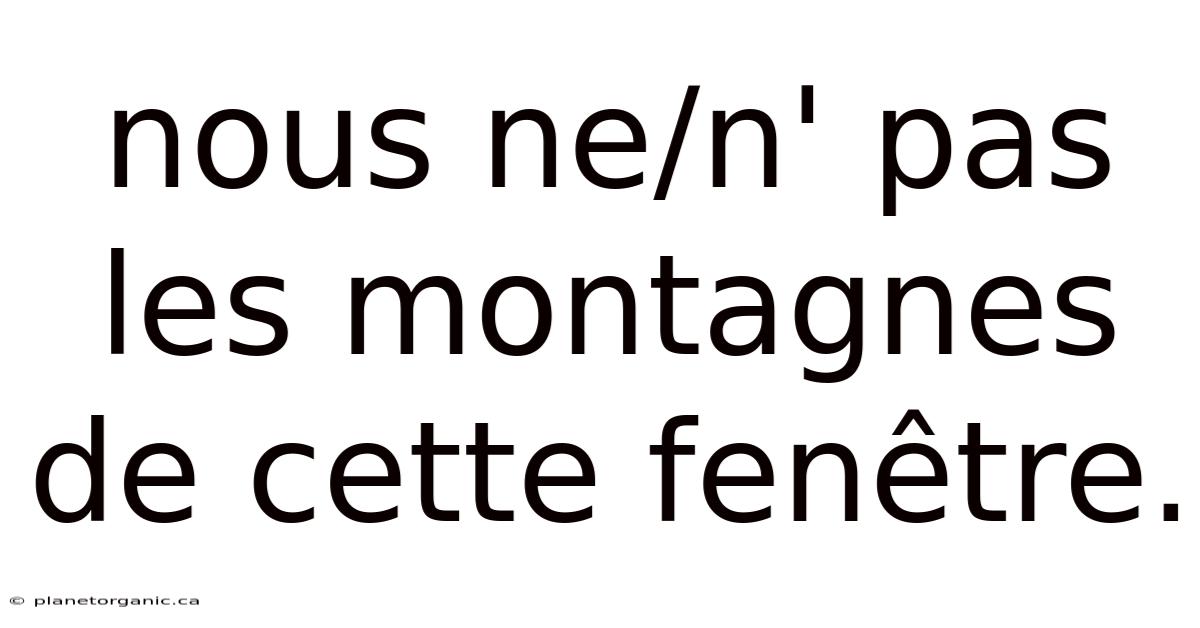
Beyond the Window: Understanding "Nous Ne/N' Pas Les Montagnes de Cette Fenêtre"
The phrase "Nous ne/n' pas les montagnes de cette fenêtre" translates literally to "We do not/don't mountains from this window.Now, " This seemingly simple sentence, however, opens a window into the nuances of French grammar, negative constructions, and even metaphorical interpretations. Understanding its grammatical structure and potential meanings unlocks a deeper appreciation for the French language and its expressive capabilities. This article will walk through the various aspects of this phrase, exploring its grammar, possible interpretations, and providing a comprehensive understanding for learners of French It's one of those things that adds up..
Decoding the Grammar: A Step-by-Step Breakdown
At its core, "Nous ne/n' pas les montagnes de cette fenêtre" is a negative sentence. To fully grasp its meaning and potential complexities, it's essential to dissect its grammatical components:
-
Nous: This is the first-person plural pronoun, meaning "we." It functions as the subject of the sentence.
-
Ne/N': This is the first part of the standard French negative construction. The "ne" is used before a verb, but when the verb starts with a vowel or a mute "h," it is elided to "n'."
-
Pas: This is the second part of the standard French negative construction. It typically follows the verb in a simple tense.
-
Les: This is the plural definite article, meaning "the." It precedes the noun "montagnes" and indicates that we are talking about specific mountains.
-
Montagnes: This is the noun, meaning "mountains." It's plural and functions as the direct object in this sentence.
-
De: This is a preposition that can have several meanings, including "of," "from," or "about."
-
Cette: This is a demonstrative adjective, meaning "this." It agrees in gender and number with the noun it modifies.
-
Fenêtre: This is the noun, meaning "window." It's feminine singular.
Which means, the phrase essentially uses a negative construction to express that "we" do not perceive or have a specific relationship with "the mountains from this window." The exact nature of this relationship requires further exploration of potential verbs that are implicitly suggested by the sentence structure And that's really what it comes down to. Practical, not theoretical..
Unveiling the Implicit Verb: What are we not doing?
The absence of a verb in the literal translation is key to understanding the phrase's ambiguity and potential interpretations. The structure suggests an omitted verb that connects "nous" with "les montagnes de cette fenêtre." Here are some of the most likely implicit verbs, along with examples of how the sentence would look with each verb included:
And yeah — that's actually more nuanced than it sounds.
-
Voir (To see): Nous ne voyons pas les montagnes de cette fenêtre. (We do not see the mountains from this window.) This is perhaps the most straightforward interpretation. It suggests a physical obstruction or the location of the window preventing a view of the mountains.
-
Avoir (To have): Nous n'avons pas les montagnes de cette fenêtre. (We do not have the mountains from this window.) This could imply a lack of ownership or access to the mountains as viewed from the window. It might suggest that the view belongs to someone else or that access to the window itself is restricted.
-
Posséder (To possess): Nous ne possédons pas les montagnes de cette fenêtre. (We do not possess the mountains from this window.) Similar to "avoir," this emphasizes the lack of ownership of the mountains as seen from the window.
-
Atteindre (To reach): Nous n'atteignons pas les montagnes de cette fenêtre. (We do not reach the mountains from this window.) This interpretation suggests a lack of connection or influence over the mountains as viewed. It could imply a metaphorical distance or inability to affect the situation.
-
Contrôler (To control): Nous ne contrôlons pas les montagnes de cette fenêtre. (We do not control the mountains from this window.) This suggests a lack of authority or power over the mountains and what they represent Most people skip this — try not to..
The choice of the implicit verb significantly alters the meaning of the sentence. The context in which the phrase is used would provide crucial clues as to which interpretation is intended That's the part that actually makes a difference..
Exploring Possible Scenarios: Contextual Interpretations
To further illustrate the various meanings, let's examine some hypothetical scenarios where the phrase "Nous ne/n' pas les montagnes de cette fenêtre" might be used:
-
Scenario 1: Physical Obstruction: Imagine a group of people looking out of a window, but a tall building completely blocks their view of the mountains. In this case, the implied verb would likely be "voir," and the sentence would mean, "We cannot see the mountains from this window because something is obstructing our view."
-
Scenario 2: Lack of Ownership/Access: Consider a family visiting a vacation home. They can see beautiful mountains from one particular window, but that window belongs to a separate apartment. They might say, "Nous n'avons pas les montagnes de cette fenêtre," implying that they admire the view but don't have access to it.
-
Scenario 3: Metaphorical Distance: In a more abstract context, the mountains could symbolize challenges or goals. A team struggling to achieve a specific objective might say, "Nous n'atteignons pas les montagnes de cette fenêtre," meaning they feel distant from their goals and unable to overcome the obstacles in their path Nothing fancy..
-
Scenario 4: Social Commentary: The sentence could be used in a social commentary context. Here's one way to look at it: a marginalized community might say, "Nous ne possédons pas les montagnes de cette fenêtre," to express their lack of control over resources or opportunities represented by the mountains. This implies a sense of powerlessness and exclusion.
The Importance of "De Cette Fenêtre": The Window as a Perspective
The phrase "de cette fenêtre" (from this window) is crucial to the sentence's meaning. It specifies that the relationship (or lack thereof) with the mountains is tied to a particular perspective – the window. This adds another layer of complexity to the interpretation:
Honestly, this part trips people up more than it should.
-
Limited Perspective: The window represents a specific viewpoint, which might be limited or biased. The sentence could imply that the speaker's understanding of the mountains (or whatever they represent) is incomplete or skewed because it's only based on what they can see from this particular vantage point Not complicated — just consistent. Nothing fancy..
-
Distance and Separation: The window creates a physical separation between the viewer and the mountains. This separation can be literal (the windowpane) or metaphorical (a barrier to understanding or connection).
-
Focus and Clarity: Conversely, the window can also provide focus and clarity. By framing the view, it can highlight specific aspects of the mountains and draw attention to certain details.
Which means, "de cette fenêtre" suggests that the speaker's experience is shaped by the limitations and possibilities of the window as a metaphorical lens.
Nuances of Negation: "Ne...Pas" and Beyond
The French negative construction "ne...pas" is generally straightforward, but don't forget to remember a few nuances:
-
Elision: As mentioned earlier, "ne" becomes "n'" before a vowel or mute "h." This is crucial for correct pronunciation and grammatical accuracy.
-
Other Negative Words: "Pas" is the most common negative word, but others exist, such as jamais (never), plus (no longer), rien (nothing), and personne (nobody). These words replace "pas" in the negative construction Small thing, real impact..
-
Exceptions: There are some exceptions to the standard "ne...pas" rule, particularly in formal or literary French. Sometimes, "ne" is used without "pas" in certain expressions or clauses.
Understanding these nuances ensures accurate interpretation and construction of negative sentences in French.
Alternative Interpretations: Beyond the Literal
While the most common interpretations of "Nous ne/n' pas les montagnes de cette fenêtre" revolve around seeing, having, or reaching the mountains, other metaphorical interpretations are possible:
-
Aesthetic Appreciation: The sentence could express a lack of appreciation for the beauty of the mountains as seen from the window. Perhaps the speaker finds the view uninspiring or prefers a different perspective.
-
Emotional Connection: It could suggest a lack of emotional connection to the mountains. Maybe the speaker feels indifferent or detached from the landscape.
-
Intellectual Understanding: The sentence could imply a lack of intellectual understanding of the mountains, their history, or their significance. The speaker might be aware of their existence but lack deeper knowledge or comprehension That's the part that actually makes a difference..
These alternative interpretations highlight the richness and flexibility of the French language, allowing for nuanced expression of complex ideas and emotions.
Mastering French Grammar: A Foundation for Understanding
Understanding a seemingly simple phrase like "Nous ne/n' pas les montagnes de cette fenêtre" requires a solid foundation in French grammar. Here are some key areas to focus on:
-
Verb Conjugation: Mastering verb conjugations is essential for understanding tense and mood. Pay close attention to regular and irregular verbs, as well as compound tenses Took long enough..
-
Pronouns: Familiarize yourself with different types of pronouns, including subject pronouns, object pronouns, and reflexive pronouns.
-
Prepositions: Understanding the various meanings and uses of prepositions is crucial for constructing grammatically correct sentences.
-
Adjectives: Learn how adjectives agree in gender and number with the nouns they modify.
-
Sentence Structure: Practice analyzing and constructing different types of sentences, including simple, compound, and complex sentences Not complicated — just consistent..
By mastering these fundamental grammatical concepts, you'll be well-equipped to tackle more complex phrases and understand the nuances of the French language Which is the point..
Practical Exercises: Applying Your Knowledge
To solidify your understanding of "Nous ne/n' pas les montagnes de cette fenêtre" and related concepts, try these practical exercises:
-
Translate the sentence with different implicit verbs: Rewrite the sentence, explicitly including verbs like voir, avoir, atteindre, contrôler. How does the meaning change with each verb?
-
Create different scenarios: Imagine different contexts where the sentence might be used. What would be the most likely interpretation in each scenario?
-
Analyze the phrase "de cette fenêtre": How does the window influence the speaker's perspective? What limitations or possibilities does it create?
-
Practice using the negative construction "ne...pas": Write sentences using different negative words like jamais, plus, rien, personne Small thing, real impact. Simple as that..
-
Write a short story: Incorporate the phrase "Nous ne/n' pas les montagnes de cette fenêtre" into a short story. Explore the themes and emotions it evokes.
By actively engaging with the language, you'll deepen your understanding and improve your fluency The details matter here..
Conclusion: A Window into Linguistic Depth
The phrase "Nous ne/n' pas les montagnes de cette fenêtre" is more than just a collection of words; it's a window into the complexities and nuances of the French language. Practically speaking, by dissecting its grammatical structure, exploring potential interpretations, and considering the context in which it might be used, we gain a deeper appreciation for its expressive capabilities. The absence of a verb forces us to consider the various possibilities, while the phrase "de cette fenêtre" highlights the importance of perspective. Through this exploration, we not only understand the literal meaning but also uncover the potential for metaphorical interpretations and deeper emotional resonance. The bottom line: mastering the intricacies of this phrase and similar linguistic puzzles strengthens our understanding of French grammar and enhances our ability to communicate effectively and creatively in the language. The seemingly simple sentence serves as a reminder that language is not just about conveying information but also about shaping perception and expressing the human experience.
