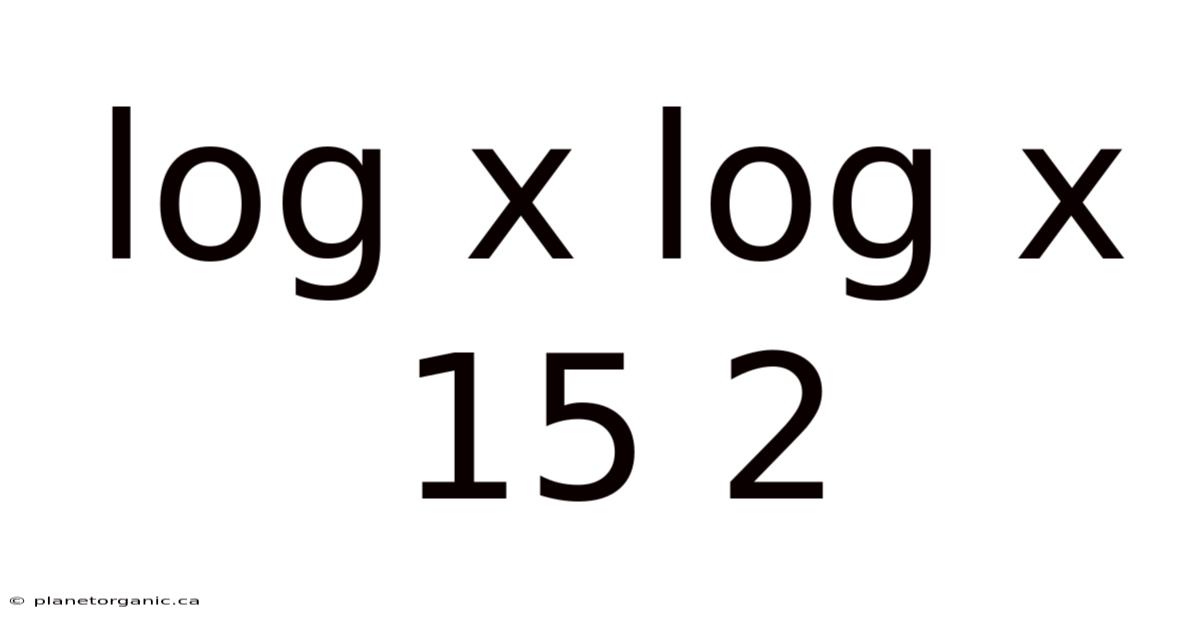
Unraveling the Mystery: Solving the Equation log x log x = 15/2
The equation log x log x = 15/2 might appear daunting at first glance. On the flip side, by understanding the properties of logarithms and applying some clever algebraic manipulations, we can systematically break down the problem and arrive at a solution. This article will guide you through the process, explaining each step in detail and shedding light on the underlying principles.
Not the most exciting part, but easily the most useful It's one of those things that adds up..
A Deep Dive into Logarithms
Before we tackle the equation directly, let's refresh our understanding of logarithms. A logarithm answers the question: "To what power must we raise a certain number (the base) to get another number?"
- Formal Definition: If b<sup>y</sup> = x, then log<sub>b</sub>(x) = y. Here, b is the base, x is the argument, and y is the logarithm.
- Common Logarithm: When the base is 10, it's called the common logarithm, often written as log(x) without explicitly mentioning the base.
- Natural Logarithm: When the base is e (Euler's number, approximately 2.71828), it's called the natural logarithm, written as ln(x).
- Key Properties:
- log<sub>b</sub>(1) = 0 (Any number raised to the power of 0 equals 1)
- log<sub>b</sub>(b) = 1 (Any number raised to the power of 1 equals itself)
- log<sub>b</sub>(x<sup>n</sup>) = n * log<sub>b</sub>(x) (Power rule)
- log<sub>b</sub>(x * y) = log<sub>b</sub>(x) + log<sub>b</sub>(y) (Product rule)
- log<sub>b</sub>(x / y) = log<sub>b</sub>(x) - log<sub>b</sub>(y) (Quotient rule)
- log<sub>b</sub>(x) = log<sub>a</sub>(x) / log<sub>a</sub>(b) (Change of base formula)
These properties are crucial for manipulating logarithmic expressions and solving logarithmic equations. In the context of our equation, log x log x = 15/2, we'll assume the base is 10, as the base is not explicitly stated. So, log x refers to log<sub>10</sub>(x).
Deconstructing the Equation: log x log x = 15/2
The equation log x log x = 15/2 can be rewritten as (log x)<sup>2</sup> = 15/2. This form is much easier to work with. Our goal is to isolate x, but first, we need to isolate log x.
Step-by-Step Solution:
-
Take the square root of both sides:
√((log x)<sup>2</sup>) = √(15/2)
|log x| = √(15/2)
This step introduces the absolute value because the square root of a squared term is always non-negative And that's really what it comes down to..
-
Consider both positive and negative roots:
log x = √(15/2) OR log x = -√(15/2)
We have two possible values for log x.
-
Solve for x in each case:
-
Case 1: log x = √(15/2)
To find x, we need to undo the logarithm. Since we're using the common logarithm (base 10), we raise 10 to the power of both sides:
x = 10<sup>√(15/2)</sup>
x = 10<sup>√(7.5)</sup>
x ≈ 10<sup>2.7386</sup>
x ≈ 547.82
-
Case 2: log x = -√(15/2)
Similarly, we raise 10 to the power of both sides:
x = 10<sup>-√(15/2)</sup>
x = 10<sup>-√(7.5)</sup>
x ≈ 10<sup>-2.7386</sup>
x ≈ 0.001825
-
Because of this, the solutions to the equation log x log x = 15/2 are approximately x ≈ 547.In real terms, 82 and x ≈ 0. 001825.
Verification and Domain Considerations
It's always a good practice to verify our solutions by plugging them back into the original equation. Also, we need to consider the domain of the logarithm function. So, x must be greater than 0. The logarithm of a non-positive number is undefined. Both our solutions satisfy this condition.
Honestly, this part trips people up more than it should It's one of those things that adds up..
-
Verification for x ≈ 547.82:
log(547.82) ≈ 2.7386
(log(547.82))<sup>2</sup> ≈ (2.7386)<sup>2</sup> ≈ 7.5 ≈ 15/2
-
Verification for x ≈ 0.001825:
log(0.001825) ≈ -2.7386
(log(0.001825))<sup>2</sup> ≈ (-2.7386)<sup>2</sup> ≈ 7.5 ≈ 15/2
Both solutions are valid Which is the point..
Alternative Approaches and Insights
While the above method is straightforward, let's explore alternative approaches and gain some deeper insights.
1. Using Exponential Form Directly:
We have (log x)<sup>2</sup> = 15/2. Let y = log x. Then y<sup>2</sup> = 15/2. So, y = ±√(15/2). This is the same as step 2 in our previous method. Then, since y = log x, we have log x = ±√(15/2). Converting this to exponential form gives us x = 10<sup>±√(15/2)</sup>, which leads to the same solutions as before Small thing, real impact..
2. Graphical Interpretation:
We can graph the function f(x) = (log x)<sup>2</sup> and the horizontal line y = 15/2. 82* and the other to *x ≈ 0.Here's the thing — this provides a visual confirmation of our solutions. The x-coordinates of the points where the graph of f(x) intersects the line y = 15/2 represent the solutions to the equation. Even so, the graph will show two intersection points, one corresponding to x ≈ 547. 001825 Worth knowing..
This is the bit that actually matters in practice And that's really what it comes down to..
3. Generalization:
Consider the equation (log x)<sup>2</sup> = k, where k is a positive constant. Then, log x = ±√k, and x = 10<sup>±√k</sup>. This generalization allows us to quickly solve equations of this form by simply plugging in the value of k It's one of those things that adds up..
Common Mistakes to Avoid
- Forgetting the absolute value: When taking the square root of both sides, remember to consider both positive and negative roots. Failing to do so will result in missing one of the solutions.
- Ignoring the domain of the logarithm: Always check that your solutions are within the domain of the logarithm function (i.e., x > 0).
- Incorrectly applying logarithmic properties: Ensure you understand and correctly apply the properties of logarithms when manipulating the equation.
- Rounding errors: When using a calculator, avoid rounding intermediate results to maintain accuracy.
Advanced Considerations: Different Bases
Our solution assumed a base of 10 for the logarithm. What if the base was different? Let's explore the general case:
(log<sub>b</sub> x)<sup>2</sup> = 15/2
-
Take the square root of both sides:
|log<sub>b</sub> x| = √(15/2)
-
Consider both positive and negative roots:
log<sub>b</sub> x = √(15/2) OR log<sub>b</sub> x = -√(15/2)
-
Solve for x in each case:
-
Case 1: log<sub>b</sub> x = √(15/2)
x = b<sup>√(15/2)</sup>
-
Case 2: log<sub>b</sub> x = -√(15/2)
x = b<sup>-√(15/2)</sup>
-
So, the solutions are x = b<sup>√(15/2)</sup> and x = b<sup>-√(15/2)</sup>, where b is the base of the logarithm.
-
Example: Base e (Natural Logarithm)
If the base is e, then the solutions are:
x = e<sup>√(15/2)</sup> ≈ e<sup>2.7386</sup> ≈ 15.46
x = e<sup>-√(15/2)</sup> ≈ e<sup>-2.7386</sup> ≈ 0.0647
The solutions change significantly depending on the base of the logarithm.
The Importance of Understanding Logarithms
Logarithms are not just abstract mathematical concepts; they have numerous applications in various fields, including:
- Science: Measuring the intensity of earthquakes (Richter scale), the acidity or alkalinity of a solution (pH scale), and the brightness of stars (magnitude scale).
- Engineering: Analyzing signal processing, designing control systems, and modeling population growth.
- Computer Science: Analyzing the efficiency of algorithms (Big O notation), compressing data, and encrypting information.
- Finance: Calculating compound interest and analyzing investment growth.
A solid understanding of logarithms is essential for anyone pursuing a career in these fields Took long enough..
Practice Problems
To solidify your understanding, try solving these similar equations:
- (log x)<sup>2</sup> = 4
- (ln x)<sup>2</sup> = 9
- (log<sub>2</sub> x)<sup>2</sup> = 16
- (log x)<sup>2</sup> - 5 = 0
Remember to consider both positive and negative roots and the domain of the logarithm.
Conclusion
The equation log x log x = 15/2 might seem intimidating initially, but by breaking it down into smaller steps and applying the properties of logarithms, we can find the solutions systematically. Day to day, understanding the underlying concepts and avoiding common mistakes are crucial for success. On top of that, recognizing the broader applications of logarithms highlights their importance in various scientific and technological disciplines. On the flip side, by mastering these concepts, you'll be well-equipped to tackle more complex mathematical problems and apply your knowledge to real-world scenarios. What to remember most? That even complex equations can be solved with a combination of fundamental principles and careful, methodical application Still holds up..
